
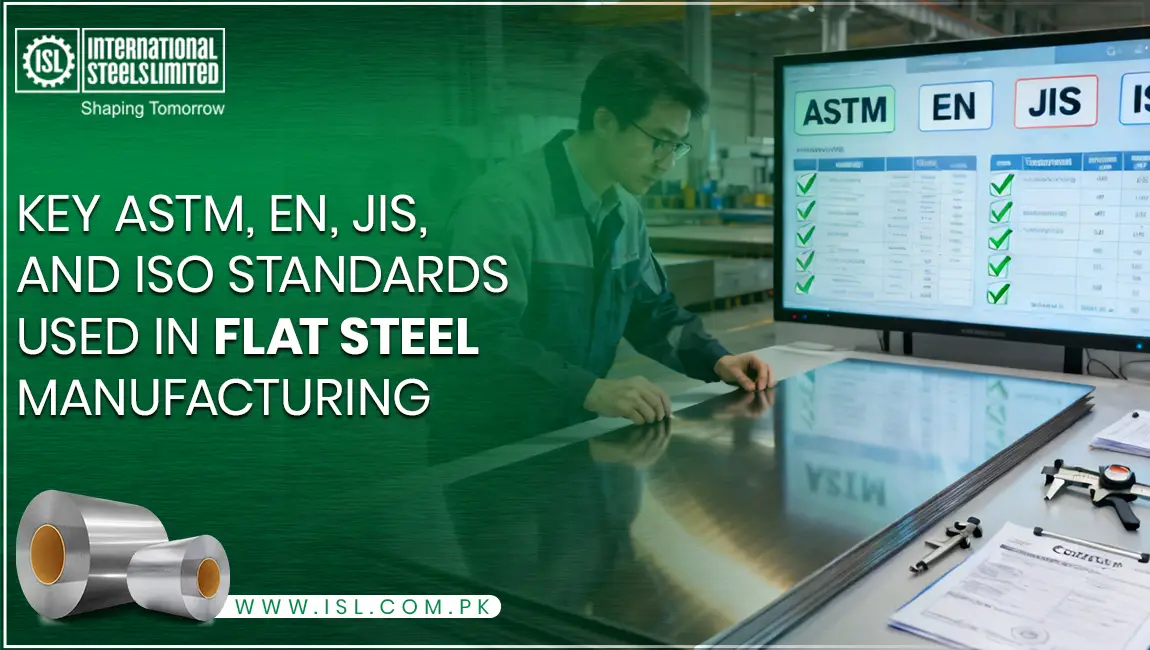
Key ASTM, EN, JIS, and ISO Standards Used in Flat Steel Manufacturing
Standards are the quiet architecture behind every reliable flat steel shipment. When engineers specify a coil or sheet, they are buying predictability encoded in internationally recognized rules. At International Steel Limited, we recognize that the difference between a high-performance structure and a structural failure lies in the fine print of a technical manual.
While standards translate metallurgical intent into measurable outcomes, ISL’s rigorous quality control (QC) protocols are what make that trust possible. In professional markets, our adherence to these benchmarks is our primary currency. By manufacturing locally to these global specs, we provide procurement teams with a critical advantage: the ability to source world-class steel without the high costs, forex volatility, and long lead times associated with imports.
At ISL, we view standards as the benchmarks that define the acceptable chemistry window, prescribe tensile behavior, and lock in dimensional expectations long before a coil leaves our mill. This shared technical language is what reduces ambiguity between buyer and producer. By adhering to these internationally recognized frameworks, ISL allows procurement teams to compare offers on a like-for-like basis, eliminating the need to decode proprietary descriptions or take risks on unverified imports.
For design engineers, these standards are a foundation rather than a limit. When you partner with ISL, you can tailor forming operations, surface treatments, and coating systems while staying strictly inside a recognized framework. This is the balance we provide: the freedom to innovate without sacrificing predictability.
The result of ISL’s standardized approach is:
- Fewer Surprises: Greater consistency during the fabrication process.
- Performance Confidence: Guaranteed structural integrity for modern infrastructure.
- Seamless Collaboration: Smoother logistics and technical alignment across the entire supply chain.
Why Standards Matter in Flat Steel Manufacturing
Standards anchor chemical composition and mechanical properties to defined ranges, removing guesswork from design calculations. A structural engineer can model yield strength with confidence because an ISL coil is constrained by precise specifications.
The ISL Advantage: Global Quality, Local Availability
- Interoperability: Global supply chains depend on a “handshake protocol.” A coil produced by ISL under a recognized specification can be fabricated or coated anywhere in the world with zero reinterpretation.
- Precision Engineering: For design engineers, these standards leave room for optimization. At ISL, we tailor forming operations and coating systems within these frameworks to ensure fewer surprises in fabrication.
- Risk Reduction: By specifying ISL’s standard-compliant steel, stakeholders reduce the probability of non-conformance claims. Our documented audit trails and Mill Test Certificates (MTCs) provide the transparency required for large-scale infrastructure projects.
4 Major International Steel Standards Bodies
The global flat steel ecosystem is shaped by several standards organizations that codify best practices into enforceable documents. Each body reflects regional priorities while contributing to a broader technical consensus. At International Steel Limited (ISL), we have strategically adopted all four of these major frameworks. This multi-standard capability ensures that our clients never have to compromise on specifications when choosing a local partner over expensive, high-lead-time imports.
ASTM Standards (United States and Global Trade)
ASTM International publishes widely adopted specifications covering chemical composition, mechanical testing, and coating performance. At ISL, our ASTM-compliant production serves as a vital bridge for Pakistan’s construction, automotive, and energy sectors. By certifying compliance with ASTM documents, we allow our partners to source world-class material locally while maintaining the design assumptions required by international contracts.
- Strong linkage between our material grades and standardized test procedures for verified performance.
- Supports seamless verification in both our in-house mill labs and third-party inspections.
EN Standards (European Norms)
EN standards harmonize material requirements across European markets, integrating mechanical properties with strict delivery conditions. For exporters, ISL’s EN compliance signals readiness for projects governed by European codes. Our focus on EN standards ensures that from order entry to shipment, our documentation meets the transparency demanded by global regulatory environments.
- Integrated delivery conditions that clarify expectations for every shipment.
- A strong orientation toward traceability, perfect for high-stakes infrastructure.
JIS Standards (Japanese Industrial Standards)
The JIS specifications reflect Japan’s legendary precision manufacturing culture—a culture we have mirrored on the ISL production floor. Flat steel grades under JIS are engineered for tight tolerances and consistent forming behavior. We utilize state-of-the-art equipment to meet these reliability benchmarks, supporting Pakistan’s automotive and appliance sectors where minor deviations can escalate into assembly issues.
- Tight tolerance frameworks that align with high-precision fabrication needs.
- An emphasis on surface integrity and repeatability in high-volume production.
ISO Standards (International Harmonization)
The International Organization for Standardization works toward global harmonization. At ISL, we use ISO standards as a reference framework to transcend regional boundaries. These standards focus on terminology, testing protocols, and quality management integration, serving as the common denominator in our multinational project collaborations.
- Global terminology alignment that reduces miscommunication between procurement teams.
- Support for an integrated quality system that is recognized on the international stage.
Standards for Cold Rolled Flat Steel
D
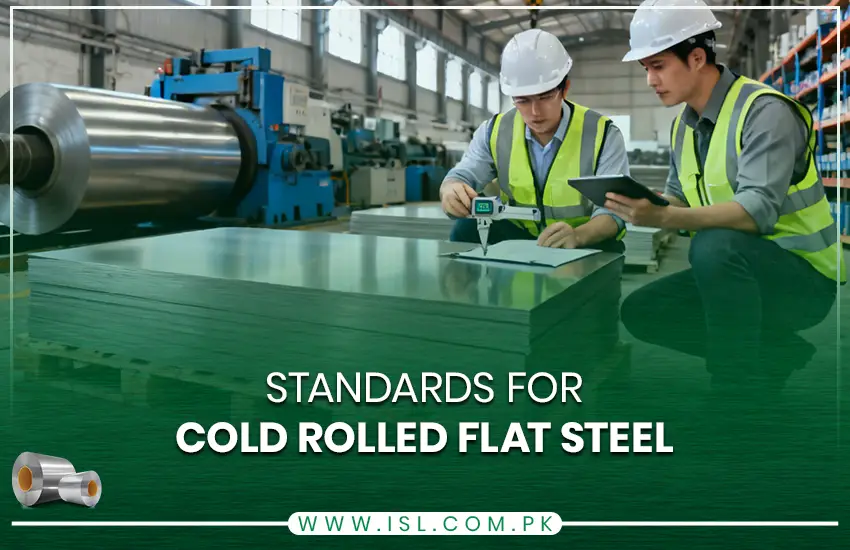
Cold rolled steel (CRC) is manufactured by reducing the thickness of pickled hot rolled coils at room temperature, producing steel with excellent surface finish, dimensional accuracy, and mechanical properties. Our cold rolled steel is produced following ASTM A1008, JIS G3141, EN 10130, and ISO 3574 standards.
- ASTM A1008 / A1008M – Specifies requirements for cold rolled carbon steel sheets and strips for commercial, drawing, and structural applications.
- JIS G3141 – Japanese Industrial Standard for commercial cold rolled steel sheets and strips.
- EN 10130 – European standard for cold rolled low carbon steel flat products for forming and structural use.
- ISO 3574 – International standard specifying dimensions and tolerances for cold rolled steel sheets.
ISL offers a wide range of grades, including commercial, drawing/automotive, structural, electrical, and tin mill black plate. The steel can be annealed, skin-passed, oiled, or unoiled, with thicknesses from 0.15 mm to 3.00 mm and widths up to 1,250 mm. Production involves pickling, cold rolling, annealing, skin-passing, tension leveling, and optional application of electrostatic oil for corrosion protection.
Quality assurance is ensured through tensile tests, cupping, hardness, bending, fluting, surface finish, and flatness measurements. Adhering to these international standards, we ensure that the steel meets the exacting requirements of automotive components, appliances, furniture, tubing, and industrial applications, providing consistent performance and reliability.
Standards for Hot Dip Galvanized Flat Steel
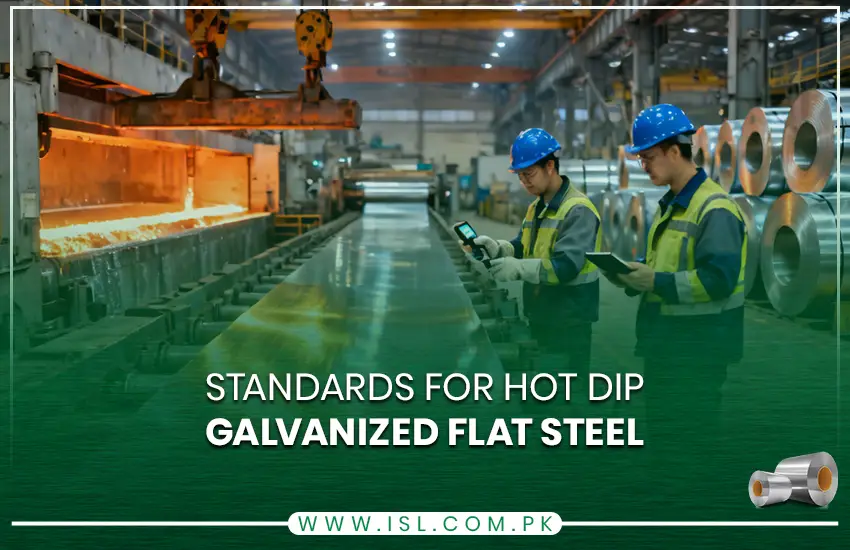
Hot dip galvanized (HDG) steel is produced by coating cold rolled or annealed steel with a protective zinc layer, which enhances corrosion resistance and extends service life. At ISL, HDG steel is manufactured in compliance with ASTM A653, JIS G3302, and equivalent international standards.
- ASTM A653 / A653M – Specifies requirements for steel sheet and strip, zinc-coated (galvanized) or zinc-iron alloy coated (galvannealed), including coating adhesion, zinc thickness, and mechanical properties.
- JIS G3302 – Japanese standard for hot dip galvanized steel sheets and strips, covering coating quality, substrate preparation, and dimensional tolerances.
- Equivalent Standards – Where applicable, EN 10346 is used for galvanized steel sheets and coils in European markets.
ISL’s HDG steel is available in various grades, including commercial, forming, structural, and drawing types, with zinc coating weights ranging from Z60 to Z275 g/m². Products may be skin-passed or non-skin-passed, chromated, and dried for enhanced performance.
Production follows a controlled process including degreasing, continuous annealing, immersion in molten zinc, tension leveling, optional skin-passing, and chromate application. The resulting steel meets rigorous international quality tests for zinc coating, adhesion, fluting, tensile strength, elongation, and hardness.
This adherence to international standards ensures HDG steel is suitable for construction, roofing, HVAC ducts, signage, storage boxes, fencing, and industrial applications, offering durable, corrosion-resistant, and formable material.
Standards for Color Coated (Pre-Painted) Flat Steel
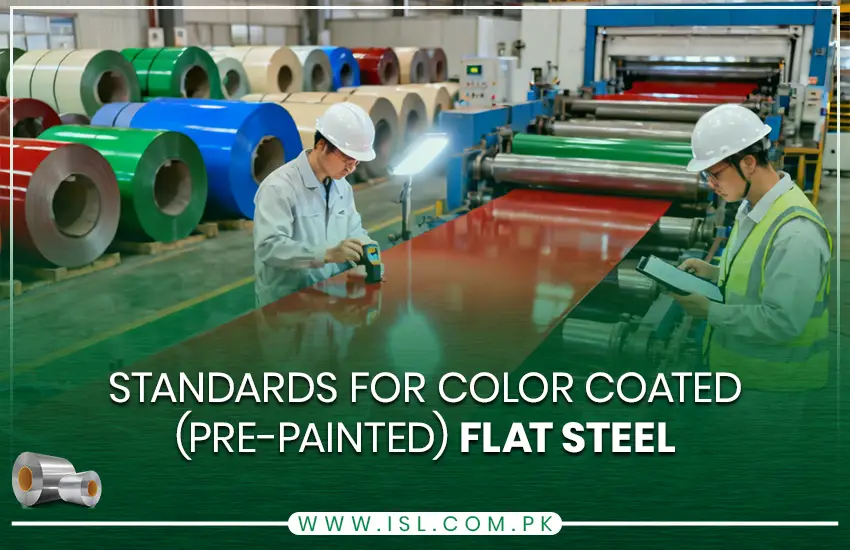
Color coated steel, also known as pre-painted steel, combines corrosion resistance with aesthetic finishes, making it ideal for architectural, commercial, and industrial applications. Our color coated steel is manufactured in accordance with ASTM A755, JIS G3312, and equivalent international standards.
- ASTM A755 – Specifies requirements for pre-painted steel sheets and coils, including coating adhesion, thickness, and performance under various environmental conditions.
- JIS G3312 – Japanese standard for color coated steel sheets and coils, covering both substrate preparation and coating quality.
- Substrate Standards – Depending on the base material, the steel complies with:
- Galvanized Steel: ASTM A653, JIS G3302, EN 10346
- Cold Rolled Steel: ASTM A1008, JIS G3141, EN 10130
At ISL, color coated steel undergoes a Two Coat – Two Bake process with primer and top coats baked to ensure adhesion and durability. The coatings include Polyester (PE) and Polyvinylidene Fluoride (PVDF), chosen according to exposure conditions. Thickness and coating quality are verified through industry-standard tests such as salt spray, cross-hatch adhesion, pencil hardness, and gloss measurement per EN 13523 and ASTM equivalents.
This strict adherence to international standards ensures that ISL’s color coated steel is corrosion-resistant, scratch-resistant, and weatherproof, making it suitable for roofing, cladding, ducting, appliances, and other demanding applications.
Documentation and Certification Requirements
At International Steel Limited, we believe that a standard is only as good as the evidence behind it. Material certification is where technical rules become auditable evidence. Our Mill Test Certificates (MTCs) are the “identity cards” for every coil we produce, providing engineers and procurement heads with traceable proof that the delivered steel meets or exceeds contractual expectations.
The ISL Traceability Framework
Our commitment to transparency is built into our production floor culture through a rigorous traceability chain:
- Heat Number Tracking: Every batch is linked to its specific melt data. This allows for precise root-cause analysis and quality assurance.
- In-House Laboratory Testing: Every MTC issued by ISL is backed by data from our state-of-the-art testing facilities, where we verify chemical composition and mechanical performance against ASTM, JIS, and EN benchmarks.
- Batch Identification: From the moment a coil is rolled to the second it arrives at your site, its “digital twin” in our system ensures a seamless audit trail.
Conformance vs. Compliance: Why the Distinction Matters
In regulated sectors like automotive manufacturing and large-scale infrastructure, understanding these two pillars is critical to maintaining a reliable supply chain:
- Conformance Documentation: This confirms that the specific test results of your shipment, such as yield strength and zinc mass, align precisely with the ordered specification (e.g., JIS G3141 or ASTM A653).
- Compliance Documentation: This demonstrates ISL’s adherence to broader regulatory or contractual frameworks, like ISO 9001:2015 quality management or environmental safety standards.
By providing both, ISL eliminates the administrative gaps that often delay project acceptance. When you partner with us, you aren’t just buying steel. You are buying the peace of mind that comes with a documented history of quality. This level of transparency is exactly what allows our partners to bypass the complexities of importing and move straight to fabrication with total confidence.
Common Challenges in Standards Compliance
Navigating the landscape of international standards is rarely straightforward. Regional variations often create interpretation friction, especially when equivalent grades between JIS, ASTM, and EN do not map perfectly. For procurement teams, this misalignment can lead to costly fabrication issues or project delays.
At International Steel Limited (ISL), we act as your technical partner to bridge these gaps. Our metallurgical experts provide the necessary judgment to validate substitutions, ensuring that the local steel you source performs exactly like the international grades your design specifies.
Overcoming the “Interpretation Gap”
Supplier interpretation differences often add a layer of complexity to high-stakes projects. Two different mills may read the same standard clause differently, which can shift the final acceptance criteria. ISL’s transparent communication and rigorous documentation neutralize this ambiguity. We provide clear, pre-documented expectations that align with your specific project benchmarks, ensuring there are no surprises once the material arrives on site.
Managing Multi-Standard Projects
Large-scale infrastructure projects frequently demand disciplined specification management, often requiring a mix of ASTM, EN, JIS, or ISO references within a single procurement package. Coordinating these requires a level of meticulous review that many importers cannot provide.
The ISL Advantage in Multi-Standard Compliance
- Upfront Alignment: Our technical sales team works with your engineers to align specifications before production begins.
- Expert Cross-Referencing: We provide verified cross-reference tables to ensure “like-for-like” performance.
- Eliminating Requalification: By sourcing compliant material locally from ISL, you avoid the requalification delays and “import friction” that occur when foreign shipments don’t meet the fine print of local codes.
By investing in this upfront alignment, our partners avoid costly revisions and move straight to fabrication with total confidence. At ISL, we don’t just follow the standards—we provide the expertise to make them work for your bottom line.
Partner with Pakistan’s Leader in Standard-Compliant Steel Solutions
At International Steel Limited, we believe technical clarity builds better partnerships. If your next project demands flat steel that aligns precisely with global standards, our team is ready to discuss specifications. Reach out to continue the conversation and translate standards into confident procurement decisions.
Frequently Asked Questions
What is the ASTM standard for steel?
There is not a single ASTM standard for steel. Instead, there are hundreds of individual standards categorized by the steel’s form, chemistry, and intended use.
What is ASTM vs ISO?
ASTM is the American Society for Testing and Materials. ISO is the International Organization for Standardization. As their name implies, ASTM is preferred in North America. On the other hand, ISO is prevalent in Europe.
How many standards are in ASTM?
There are over 13,000 active ASTM International standards in use worldwide. These standards are developed by more than 30,000 volunteer members and over 150 technical committees, covering a wide range of materials, products, systems, and services.
References
ASTM International. (2021). Standard specification for steel, sheet, cold-rolled, carbon, structural, high-strength low-alloy, high-strength low-alloy with improved formability, required hardness, solution hardened, and bake hardenable (ASTM A1008/A1008M-21a). https://www.astm.org/a1008_a1008m-21a.html
Japanese Standards Association. (2011). Cold-reduced carbon steel sheet and strip (JIS G 3141:2011). https://www.modiranahan.com/uploads/pdf/JIS-G-3141-2011.pdf
European Committee for Standardization. (2006). Cold rolled low carbon steel flat products for cold forming – Technical delivery conditions (EN 10130:2006). https://www.modulusmetal.com/en-10130-standard-guide/
International Organization for Standardization. (2012). Cold-reduced carbon steel sheet of commercial and drawing qualities (ISO 3574:2012). https://www.iso.org/standard/60589.html
ASTM International. (2020). Standard specification for steel sheet, zinc-coated (galvanized) or zinc-iron alloy-coated (galvannealed) by the hot-dip process (ASTM A653/A653M-20). https://www.astm.org/a0653_a0653m-20.html
Japanese Standards Association. (2019/2024). Hot-dip zinc-coated steel sheet and strip (JIS G 3302). https://webstore.ansi.org/preview-pages/jis/preview_jis_g_03302_000_000_2019_e_ed10_ch.pdf?srsltid=AfmBOoqHSXekueTLJkyQaAFBBtMis53Krf2uHc-JM9HEY-InrvyK3Ma8
ASTM International. (2018). Standard specification for steel sheet, metallic coated by the hot-dip process and prepainted by the coil-coating process for exterior exposed building products (ASTM A755/A755M-18). https://www.astm.org/a0755_a0755m-18.html
Japanese Standards Association. (2024). Prepainted hot-dip zinc-coated steel sheet and strip (JIS G 3312:2024). https://webdesk.jsa.or.jp/preview/pre_jis_g_03312_000_000_2024_e_ed10_ch.pdf